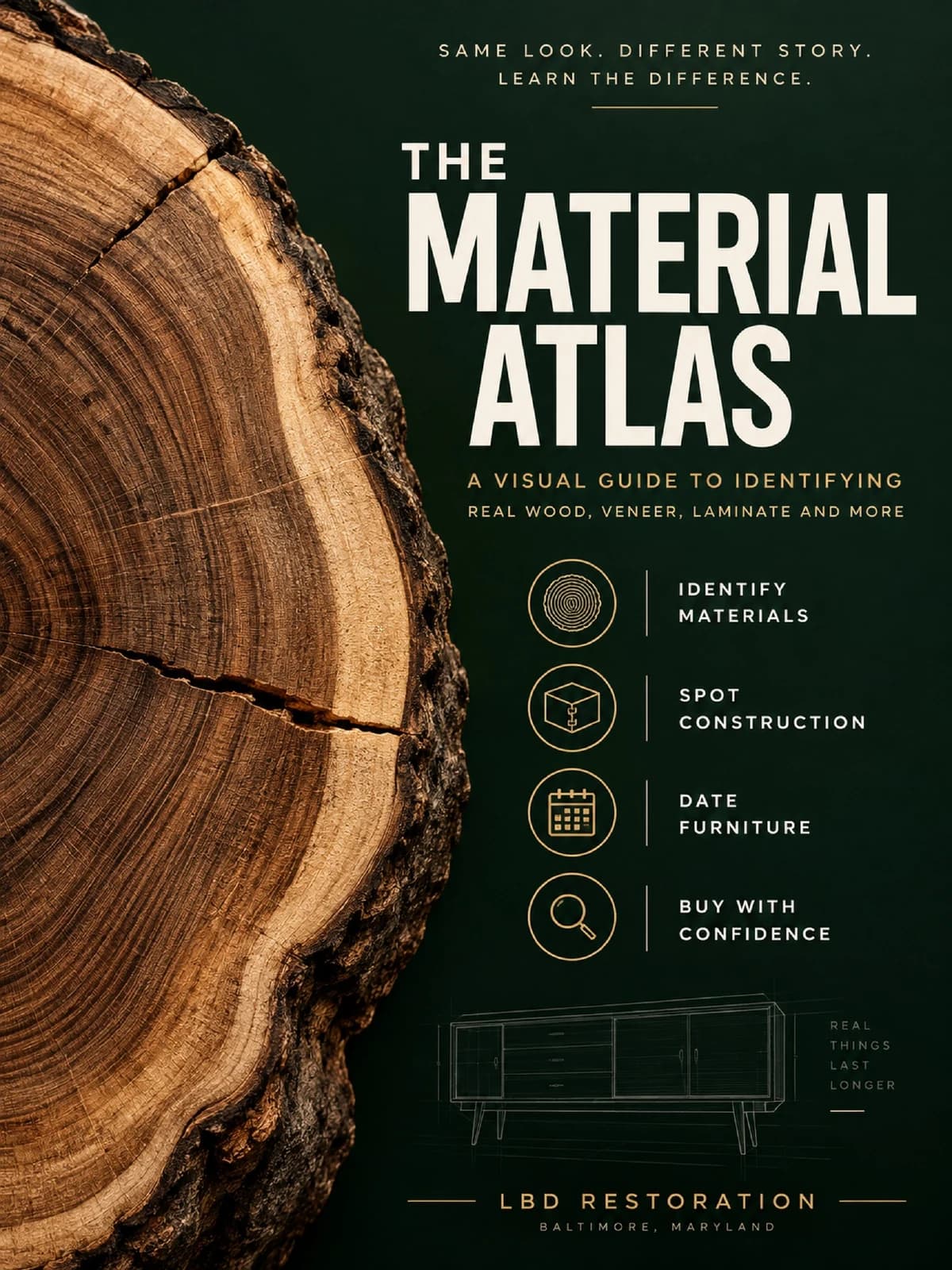
The Material Atlas
A Visual Guide to Identifying Real Wood, Veneer, Laminate and More
Read a finish, a face, an edge and an inside — in that order — and say what a piece is made of with a stated level of certainty.
- Buyers who have been told “solid walnut” one too many times
- Collectors and dealers who want a repeatable material check
- Restorers and refinishers deciding what a surface will take
- Anyone who has ever bought “teak” that turned out to be a print
By the last page,you will be able to:
- 01Tell solid from veneer from laminate with a three-question check
- 02Say which of eight woods you’re probably looking at — and how sure you are
- 03Spot color that comes from a stain, a lamp or a camera rather than the wood
- 04Read an edge, a drawer and an underside the way a restorer does
- 05Separate the usual signs of age from damage
- 06Ask for the one photograph that would settle it instead of guessing from a listing
- 07Say “I can’t tell yet” and mean it as an expert answer
Outside in. Four placesto look, in order.
The same check runs through the whole book, and sections four to seven follow it step by step. By the end it is something you do without the book in front of you.
Finish
Oil or film. Stained or not. Original or redone.
Face
Pores first, then rays, streaks or stripe. Color last.
Edge
Grain wraps: solid. Stops at a line: veneer. Exact repeat: print.
Inside
Raw wood, drawer sides, the core at a chip or screw hole.
Color and a hunch. Where every identification starts, and where most listings stop.
Two clues agree — pores and figure, say — and nothing argues.
You've seen the clue that decides it, clearly.
Confirmed, not just seen. Usually the piece in your hands. Nothing on a screen gets here.
What’s in it.
- The Material Check
- Finish → Face → Edge → Inside → then call it. The four-step method that runs through the whole book and fits on a pocket card.
- The Confidence Meter
- Guess → Likely → Confident → Verified. Every identification ends with a name and a level of certainty, never a name alone.
- Eight species cards
- The woods you’ll actually meet in vintage furniture, each with its fingerprint, its easily-confused-with, and where you’ll find it.
- Material matchups
- Two materials, one deciding clue, four rounds — practice before it costs money.
- Test your eye
- Eight details, three choices each, and when “I can’t tell yet” is the right answer.
In the field.
Decide from the photographs whether the material claim is a guess, and which single photo to ask for.
Run the Material Check in order. Most solid-versus-veneer calls take seconds once an edge is in view.
Put a confidence level on your call, and know what would move it to Verified.
- 86 pages, eleven sections
- Screen Edition (the Library reader edition) and a US Letter Print Edition
- The Material Check pocket card, 4×6 and Letter two-up
- Protected downloads and the in-site reader, from My Library
$47
After you buy, sign in with the email you used at checkout and open My Library once. Then the Photo Check tab is yours to use.
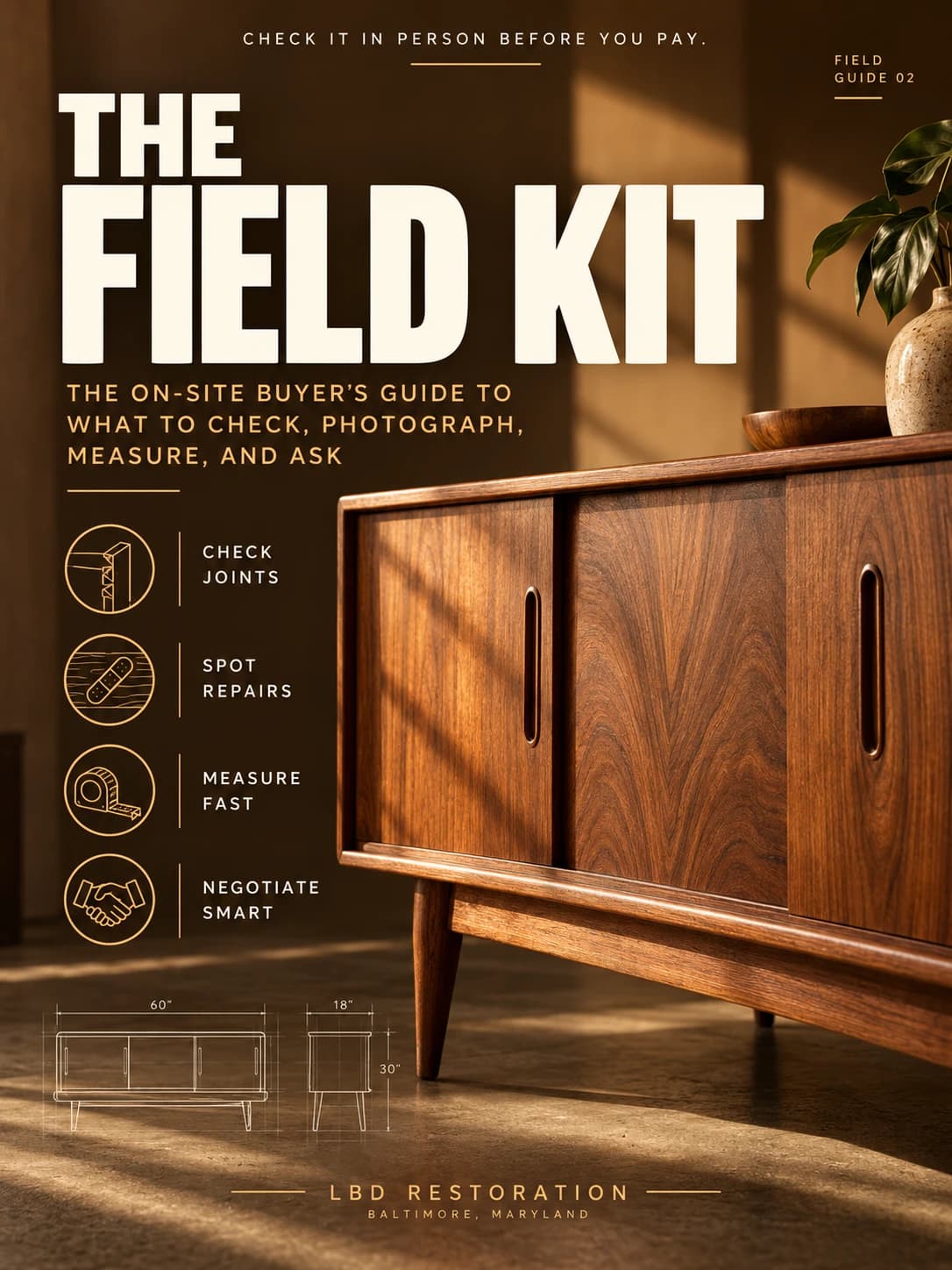
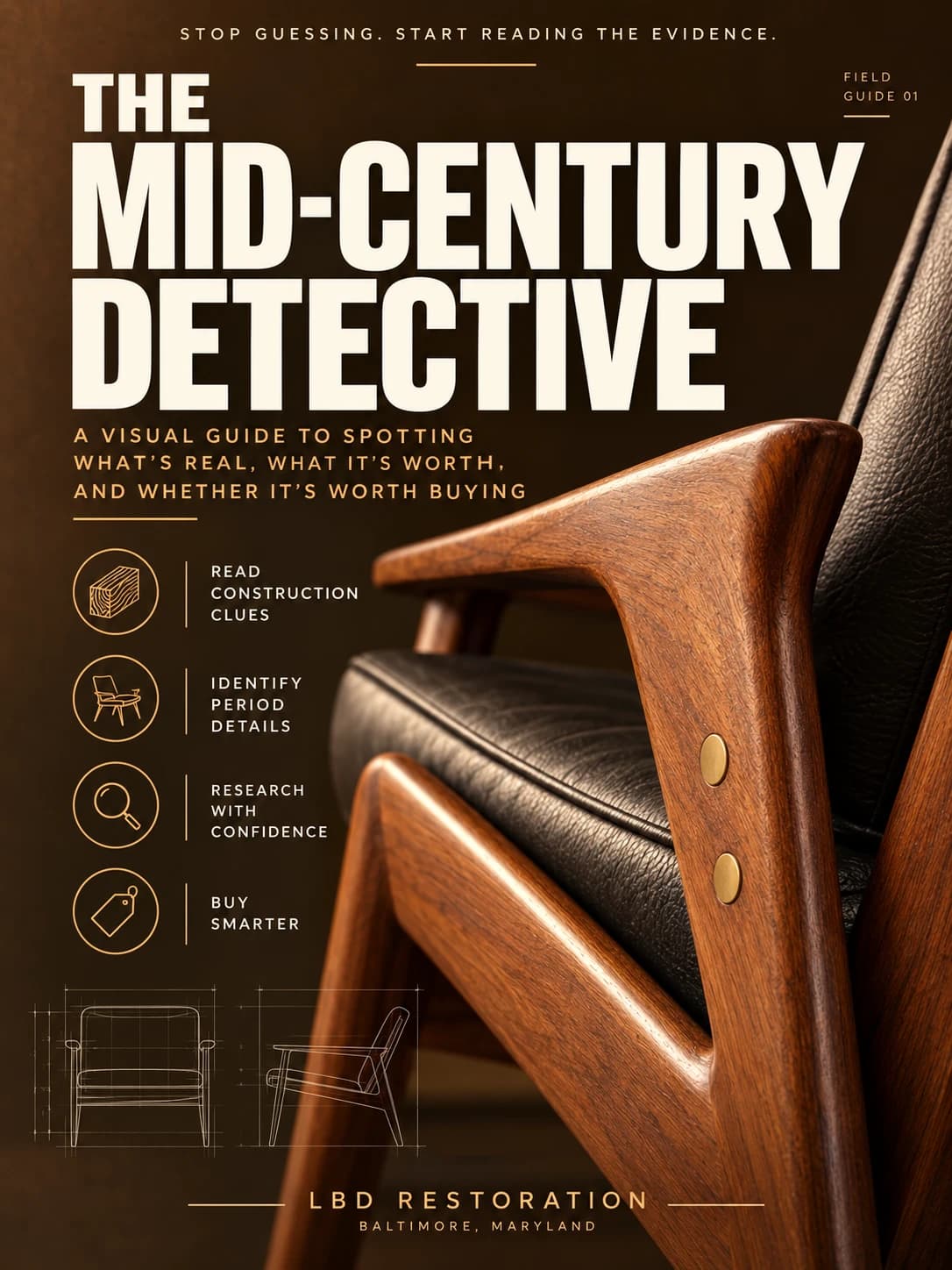
See it. Inspect it. Understand it.
For $50 more than The Material Atlas alone, you get the whole system: identify the material, inspect the piece, and work out what it really is.
- 01Step 1 · IdentifyThe Material Atlasthis guide
- 02Step 2 · InspectThe Field Kit
- 03Step 3 · InvestigateThe Mid-Century Detective
- Is this a woodworking book?
- No. It is a buyer’s identification system. It teaches you to read what is in front of you, not to build it.
- Do I need the other two guides?
- Each works on its own. The Atlas answers “what is it made of”; The Field Kit gives you the on-site process and The Detective the research and evaluation. The bundle exists for people who want the whole system.
- Can I read it on my phone?
- Yes — in the My Library reader, and as the Screen Edition PDF.
- Do I need an account to buy it?
- No. Guest checkout works. A free LBD account using the same email adds the reader and saved progress.
10% off your first course, and a furniture lesson in your inbox now and then.