The Mid-Century Detective
A Visual Field Guide to Identifying, Researching & Evaluating Vintage Furniture
Connect construction, materials, proportion, wear and markings into an identification you can research — and a buying decision you can defend.
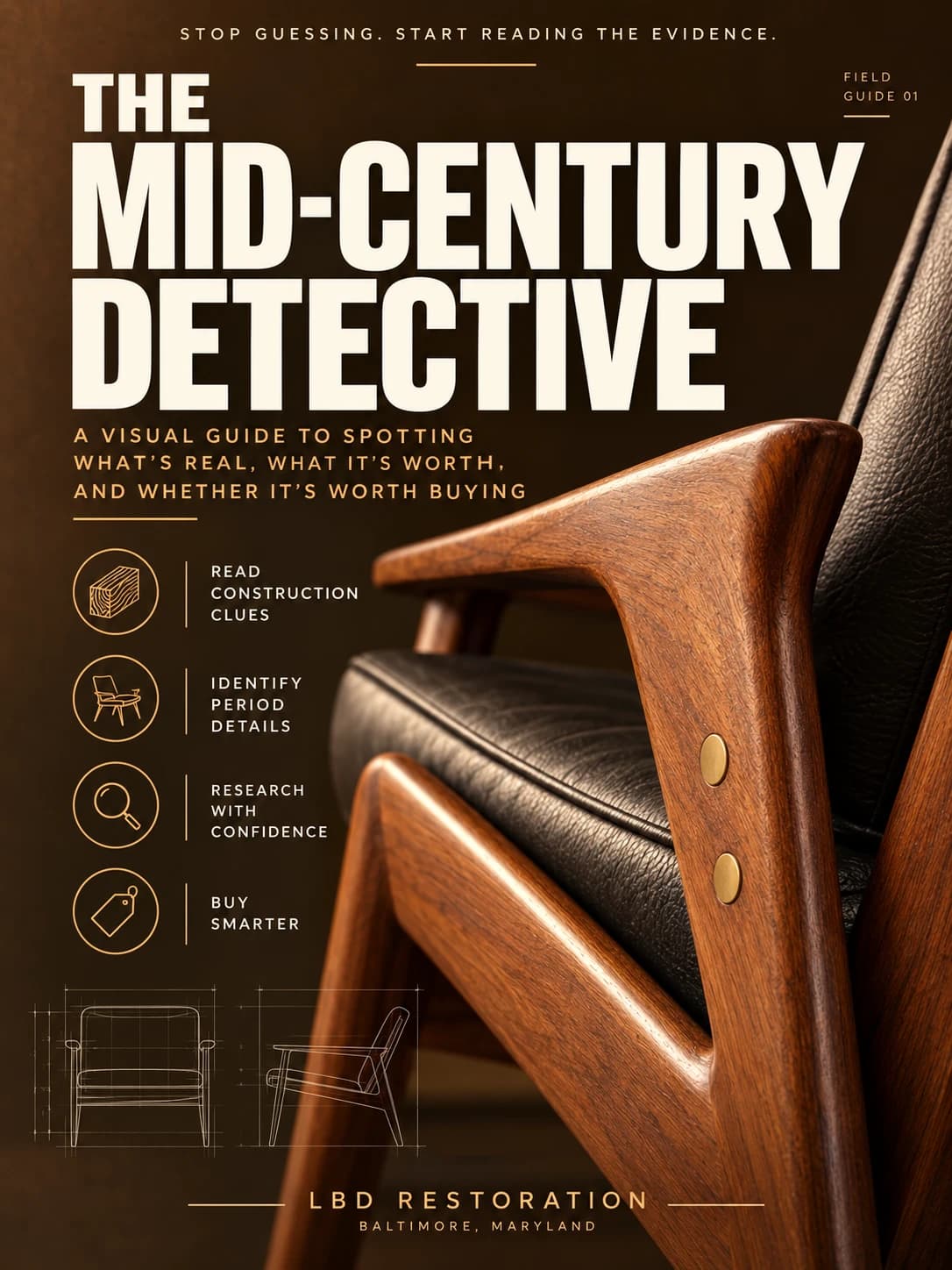
- Buyers who love mid-century furniture and want to stop guessing
- Anyone deciding whether a piece is what the listing says it is
- Collectors researching a maker, a line or a period
- People who want to know what still needs checking before the money changes hands
By the last page,you will be able to:
- 01Learn to Look — the habits that separate observation from assumption
- 02Read the Object — materials, construction, joinery, hardware, proportion and silhouette, wear and patina, labels and markings
- 03Furniture Case Files — credenzas, dressers, lounge and dining chairs, coffee and side tables, desks
- 04Real or Repro? — the questions that expose a reproduction
- 05The Marketplace Field Guide — what listing photographs deserve a closer look
- 06A Research Workflow for the questions the piece can’t answer itself
Seven kinds of evidence,in the order you meet them.
Part II of the guide is the method: one chapter per kind of evidence, so you examine before you interpret and know what each clue can actually support.
Materials
Solid, veneer, laminate — and which wood, from the surface you can see.
Construction
How the case, the frame and the carcass were actually put together.
Joinery
How the parts are joined — the detail that most often separates the era from the reproduction.
Hardware
Pulls, hinges and glides: original, replaced, or a later upgrade.
Proportion & Silhouette
What the outline can show — and what it can't.
Wear & Patina
Separating honest age from damage, and both from disguise.
Labels & Markings
Stamps, tags, pencil marks and what each one can and cannot prove.
What the piece itself showed you.
What the listing, the seller or the style suggested.
What still needs research before the money changes hands.
What’s in it.
- Part I — Learn to Look
- How to examine before you interpret.
- Part II — Read the Object
- Seven chapters, one per kind of evidence.
- Part III — Furniture Case Files
- Six furniture types, worked as cases.
- Part IV — Real or Repro?
- The reproduction questions.
- Parts V & VI
- The Marketplace Field Guide and the Research Workflow.
In the field.
Know which details in marketplace photographs deserve a closer look before you make the trip.
Examine materials, construction, joinery, hardware, proportions, wear, labels and markings systematically.
Separate what you have observed from what you are assuming — then know what still needs to be researched.
- 73 pages, six parts
- Instant PDF download
- Protected downloads and the in-site reader, from My Library
$47
After you buy, sign in with the email you used at checkout and open My Library once. Then the Photo Check tab is yours to use.
See it. Inspect it. Understand it.
For $50 more than The Mid-Century Detective alone, you get the whole system: identify the material, inspect the piece, and work out what it really is.
- 01Step 1 · IdentifyThe Material Atlas
- 02Step 2 · InspectThe Field Kit
- 03Step 3 · InvestigateThe Mid-Century Detectivethis guide
- Is this only about mid-century furniture?
- The case files are mid-century, and so is most of the marketplace it describes — but the way of looking transfers to any vintage furniture.
- Do I need the other two guides?
- No. The Detective stands alone. The Atlas goes deeper on materials and The Field Kit turns this into an on-site process; the bundle is for people who want all three.
- Do I need an account to buy it?
- No. Guest checkout works. A free LBD account using the same email adds the reader and saved progress.
10% off your first course, and a furniture lesson in your inbox now and then.